
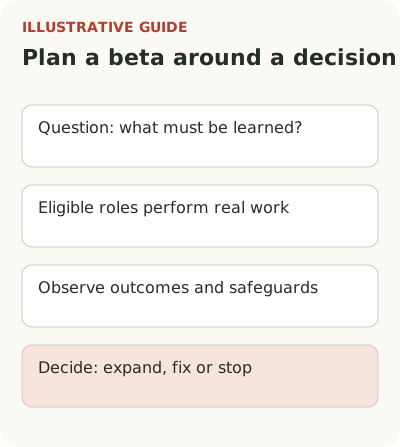
Beta testing a feature with users should end in a decision: expand access, fix a barrier or stop the workflow. Before inviting participants, record the main question, group composition, working attempt and readiness signals. General impressions won't show whether the feature is ready for wider release.
Imagine a service for legal teams adds collaborative contract review. The team doesn't know whether a lawyer and sales manager can agree on the status of a disputed clause without a separate conversation. An internal demo shows buttons but doesn't answer that question. The check needs both roles working through a real process, with clear limits and safe participation conditions.
What decision should the beta support?
Choose the main uncertainty. In the hypothetical example, it isn't “do people like collaborative review?” but “do both parties understand what a closed comment means and who makes the final decision?” The answer points to an action: clarify statuses, change permissions or recognize that the workflow currently needs a different approval process.
Record problem signals before inviting people. A manager marks a clause agreed while the lawyer considers it disputed; participants reopen a closed topic; the final document differs from the marked state. These observations are more useful than an interface rating. They connect feedback to the real work risk the team intends to remove.
Limit the scope. If you ask about the editor, notifications, roles, speed and price at once, participants will choose topics at random. You can accept other comments, but the decision to expand access should rest on questions named in advance. Otherwise the loudest request changes the beta's goal after it starts.
Complete the beta plan before inviting participants
For the hypothetical contract review, a plan could look like this:
| Plan field | Example |
|---|---|
| Decision | Whether review can expand to teams that didn't help build it |
| Main question | Do the lawyer and manager understand closure of a disputed clause in the same way? |
| Participants | Pairs of related roles from accounts with suitable contracts; mark volunteers separately |
| Working attempt | Open a disputed clause, discuss it, close it and explain who makes the final decision |
| Observation | Compare each role's explanation with document status; record disagreements and returns to messaging |
| Window | A full discussion cycle for the chosen contract; no attempt means no data yet |
| Expansion | Access errors fixed, statuses understood by both roles, help available, outcome reproducible without the feature author |
| Stop | Another person's document is exposed, comments are lost or work cannot safely continue |
Assign one owner for the decision and another for fixes. If you only need wording for a question after an attempt, use post-task feedback scenarios. A beta plan is broader than a survey: it defines whose work and which observation justify opening access.
Inviting the best-known lawyers isn't enough for collaborative review. You need related role pairs, suitable contract types and an opportunity to complete the full cycle. A lawyer testing alone might understand the menu but miss a disagreement with the manager. Group composition must reflect the dependency being tested.
Volunteers usually tolerate more difficulty than the wider customer base. Retain that limit in the conclusion. A successful beta with interested teams doesn't prove ordinary customers will understand the workflow unaided. Before broad launch, check the introduction with people who didn't help build the feature or receive personal explanations.
A Kompassify transition guide distinguishes voluntary early access from later opening to ordinary users. That's vendor advice, but the distinction helps with a new-feature beta too. Self-selection affects patience and feedback, so the groups cannot be treated as equal in a comparison.
Explain limitations and consequences to participants
Before participation, say what works, what's limited and where the feature may change. Users need to understand what happens to their data, how to leave and how to get help. For contracts, promising a safe return is particularly risky if comments from the new version can't be transferred back. Confirm the technical path first.
Choose material permitted for the check. Don't ask people to submit confidential contracts to a third-party form for easier analysis. If you can observe using an anonymized or specially prepared document, start there. For a live process, agree access under the customer's rules and collect only necessary information.
Provide a contact and expected response time. A beta doesn't oblige participants to patiently repeat a broken operation. If an error affects the final document or access, they need a way to stop. The team needs an owner who decides whether to pause the check for other participants.
What to observe during a working attempt
After the action, ask what the person tried to do, what they expected and what happened. “Which features are missing?” often shifts attention from the current barrier to a wish list. To understand the status problem, ask each role separately to describe who should take the next step.
Tie feedback to state: feature version, role, document type, action and outcome. Don't collect unnecessary personal data, but retain conditions needed to reproduce the issue. “Approval is confusing” without context gives engineering little to work with. A record that the manager interpreted closing a comment as approval of the clause provides a testable hypothesis.
Compare words and behavior. Someone may rate the feature highly out of politeness but continue approving everything in a messenger. Ask about the last contract after the test. Returning to the old method isn't always failure: perhaps the second party didn't participate. That's why context and the full cycle matter, not just a final questionnaire.
When to expand access and what to tell participants
Review comments by their effect on the main task. An access error and misunderstood decision matter more than a request to change a status color. Don't count identical requests as votes without considering group composition. Several representatives of one large customer may describe one shared process, not independent market demand.
The beta must last long enough for the work being tested. For a contract, that means preparation, discussion and decision, not merely a few days of open access. If participants didn't receive a suitable document, mark them as having made no working attempt. Don't treat silence as positive feedback or divide results by all invitees as if conditions were equal.
Keep a list of changes between attempts. A fixed status may solve the problem, but don't mix old and new version results in one metric. Ask participants to repeat only the affected part and check the previous barrier. That respects their time and provides a clearer answer than asking them to rate the whole feature again.
Set expansion conditions: critical workflows completed, material errors fixed, limitations explainable and help ready. LaunchDarkly's gradual release options are an example of separating access expansion from observing release state. Specific thresholds should follow your feature's risk, not someone else's universal percentage.
Before inviting people, complete one beta plan and test the help path with support, CS and sales. Record the expansion decision in the launch checklist; look for the main outcome in feature use, keeping training attempts and real work separate.