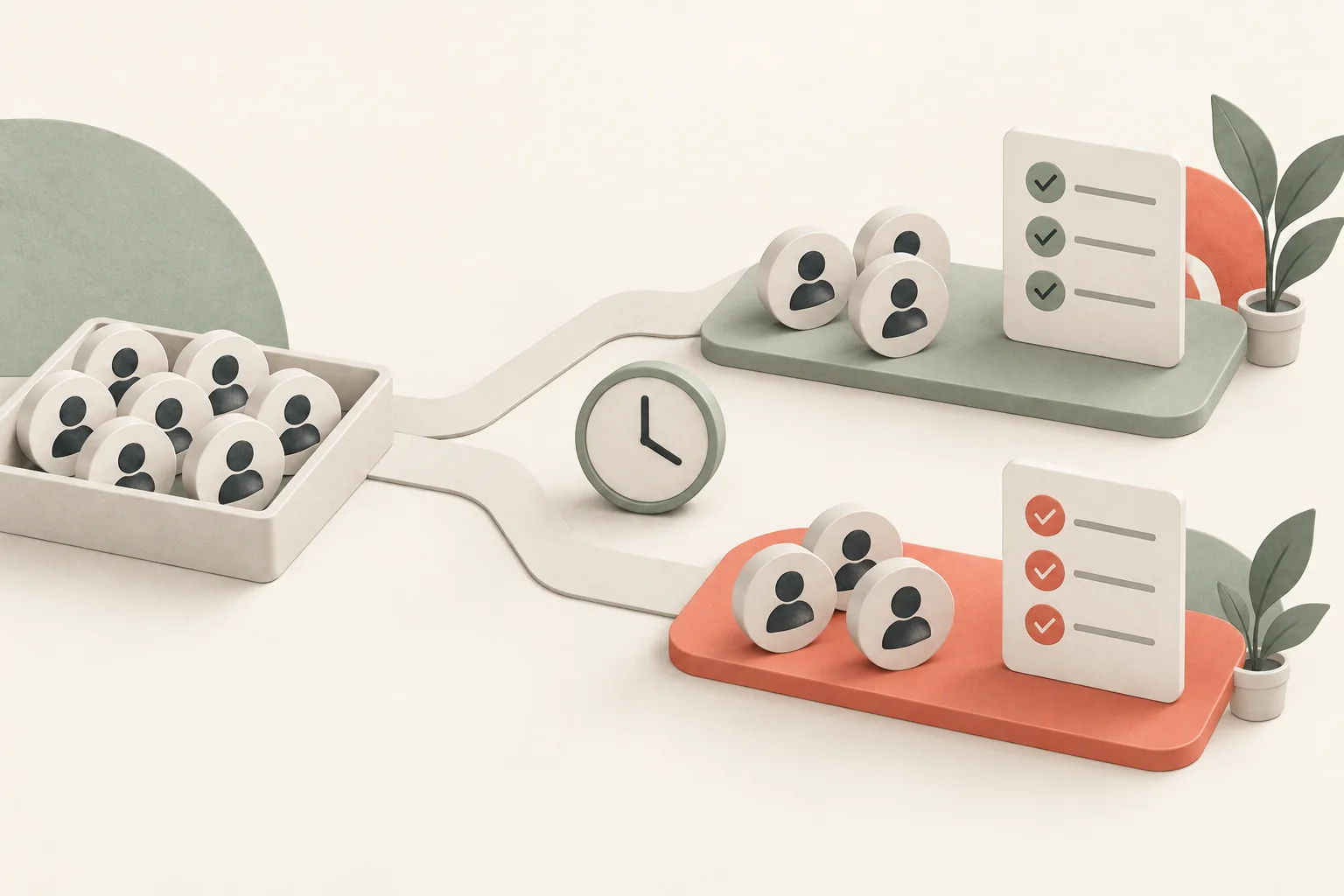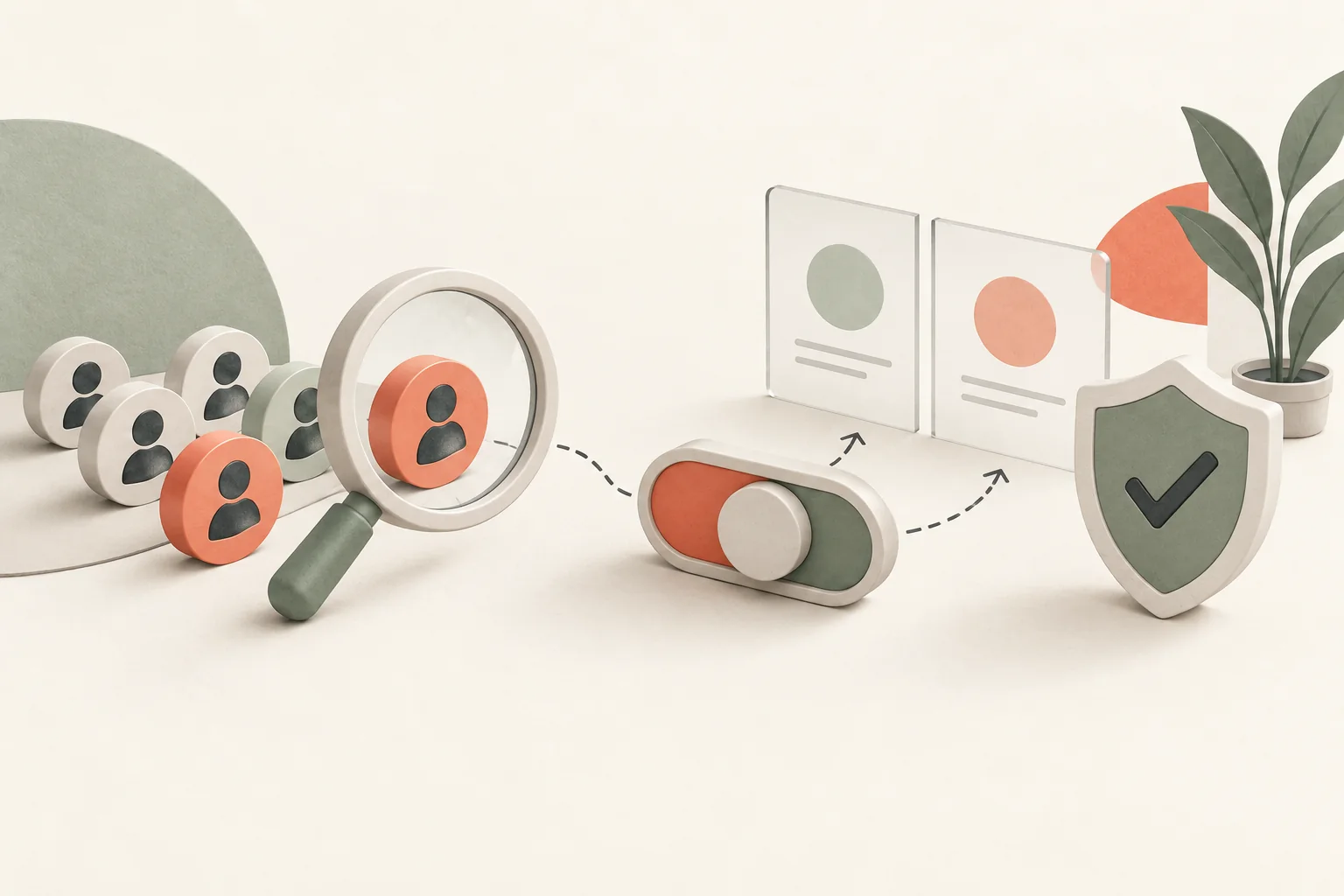
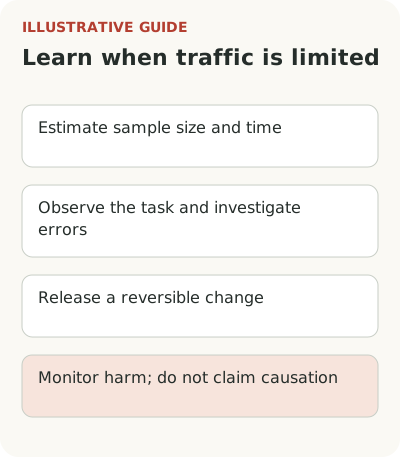
With low traffic, an A/B test may take too long to distinguish a useful effect. Estimate the flow and required precision before launch. While data is scarce, observe tasks and investigate errors without presenting those observations as a causal effect.
Imagine a procurement service receives about two dozen eligible new companies a month. The team is debating which copy to place beside catalog upload. What matters more is whether a buyer understands the file requirements and can complete the import. Comparing two phrasings at this volume can easily take longer than fixing the cause of the difficulty.
Estimate the timeline before starting a test
Suppose 20 eligible independent accounts arrive per month. With equal allocation, three months yields about 30 per variant before losses, and a 14-day outcome window adds time after recruitment ends. This is a flow calculation, not an estimate of sufficient power: power also depends on baseline conversion, the minimum useful effect and the analysis method.
| Question | Check | Limit of the conclusion |
|---|---|---|
| Is the file format clear? | Observe appropriate roles importing | Finds obstacles, not their share across the whole customer base |
| Does import fail? | Examine confirmed errors and file formats | Shows failure cases, not the effect of guidance |
| Did the outcome change? | A controlled test calculated in advance when traffic is sufficient | Requires mature windows and an assessment of uncertainty |
Record the period and all eligible cases, including failures. After a reversible change, watch errors and support; an uncontrolled before-and-after comparison doesn't prove an effect.
Clarify which answer you need now
These are different questions. “Does the person notice the button?” can be checked by observing a specific task. “Does the file pass validation?” can be checked against real formats and errors. “Does new guidance increase the share of successful imports?” requires a comparison of outcomes that accounts for uncertainty. Don't substitute one question for another to produce a familiar report.
For import copy, first find out what the person doesn't know. Do they need column names, a sample file, size limits or an explanation that old items will remain? Two versions of unhelpful copy make a tidy test with little value. Research should identify the problem worth measuring later.
Define the cost of error in advance. A tooltip with an incorrect column name is easy to fix. A change that might overwrite the catalog requires different checks, data protection and rollback readiness. Low traffic doesn't remove the need for technical checks or make a dangerous operation acceptable for a trial release.
Choose the primary outcome definition from your onboarding metrics.
Observe the task without testing people on the interface
Invite people in the relevant role and give them a work task with a clear outcome. For example, prepare a sample supplier catalog and check the resulting prices. Don't tell them where to click or which format to choose. Otherwise you're testing whether they can follow your instructions.
Record what the participant did, where they stopped, what help they requested and the result. Don't settle for “everything is clear.” Someone may politely rate the screen well and then import data incorrectly. Examine the specific stop: they missed the guidance, misunderstood a term, lacked source information or encountered an error.
A few observations can uncover causes, but they don't estimate how common those causes are across the customer base. Record the limit: “We saw this difficulty among participants with this file type.” Don't turn that into “all users need a new tour.” Next, check whether the cause appears in work events and support requests.
Use the available material carefully
Compare observations with import errors, support topics and existing events. A rare but severe failure may matter more than a frequent question resolved in a minute. Distinguish repeated occurrences of one error in one account from the number of companies affected.
With low traffic, reviewing every new eligible account over a chosen period can help. Make a short table: supplier type, source catalog availability, import outcome, reason for stopping and help required. Don't include customer file contents without a need. The error type and operation state are often sufficient for a decision.
This review can reveal external delays. For example, a buyer may be waiting for a file from a supplier. New guidance won't speed up the supplier, but saving a draft and making the next step clear could reduce repeated work. That's a different hypothesis and should be named separately.
Observing a user helps identify why a task stopped.
Release a change so you can detect harm
Once you've checked the cause, choose a small reversible change. Prepare an unchanged version, stopping criteria and a way to check the outcome. With few companies, the release's first job may be to confirm that the workflow works and introduces no new errors. Don't call that proof of a conversion increase.
Record the guidance version and when each account saw it. Watch import success, support requests and manual help. If the outcome improves after release, check the composition of new customers and concurrent changes. Perhaps companies with simpler catalogs arrived that month. Sequence in time doesn't establish cause.
A stronger conclusion needs an appropriate comparison plan. Sometimes that means account-level randomization with a long observation period; sometimes a phased rollout with qualifications. Sequential methods also require data: PostHog's documentation discusses quality checks, sample size and effect uncertainty. A calculation method doesn't create missing participants.
Don't change the entire starting journey at once if you want to understand one cause. A new form, required email and rewritten tour create several plausible explanations for the outcome. With a small flow, separating them later is especially hard. Record the scope and the other conditions the team can hold steady. If the product requires a general update, release it as such and acknowledge the analysis limit. There's no point claiming a precise test of one sentence when half the workflow changed.
Keep negative observations too. If the new explanation didn't help someone complete an import, that's a reason to reconsider the cause or form of help. Don't discard the case as an “unsuitable user” without a condition defined in advance. With low traffic, each excluded account noticeably changes the picture.
If traffic allows, prepare an onboarding A/B test card.
Decide according to the strength of evidence
If observations show that instructions contain an incorrect requirement, fix it without waiting for an A/B winner. If the hypothesis concerns a small increase in activation, the honest answer may be “not enough data yet.” These are different levels of knowledge. Preserve that distinction in the decision record.
Justify the release with what is known: a confirmed error was removed, people can perform the task, and the check found no serious harm. Leave open what hasn't been measured: the size of the effect on activation and later retention. This report supports action without manufacturing certainty.
For the coming week, choose one narrow workflow and one cause of stopping. Prepare a work task for observation, collect related errors and record the decision you'll make for each outcome. If an A/B test is still needed afterward, its question will be much sharper. If not, the team can spend the month on the product instead of waiting for unavailable precision.