
Onboarding needs one owner of the overall outcome, even when PM, CS, PMM, and engineering share the work. Assign responsibility for the scenario, data, materials, access, and problem review; a small team can combine roles.
Suppose a supply management service introduces collaborative order approval. PM considers launch to be code readiness, PMM the announcement, CS the training delivered, and engineering the absence of errors. Everyone completed their part. The customer still hasn't completed an approval. The shared outcome got lost between correctly closed tasks.
An ownership matrix for one scenario
Assign one outcome owner for the first request approval. In this example, PM owns the final decision; replace the role names with your company's actual titles. A approves and is ultimately accountable, R does the work, C is consulted, and I is informed.
| Work | PM | CS | PMM | Engineering |
|---|---|---|---|---|
| Outcome and scenario | A/R | C | C | C |
| Events and success definition | A | C | I | R |
| Copy and materials | A | C | R | C |
| Access and technical verification | A | C | I | R |
| Operation and problem review | A | R | C | R |
Each row has one A; there can be several Rs if people share the work. If analytics or support is separate, add them and assign tasks explicitly. The outcome owner also sets a review date and names someone who can stop an incorrect display.
First define what completes the launch
For the hypothetical service, a launch can count as achieved when eligible accounts have access, understand the feature's purpose, and can complete a real order with the required roles. This doesn't require every customer to achieve the same result on release day. It defines what to observe and distinguishes technical release from actual use.
State the audience, window, and constraints. A large customer with its own approval process may need implementation help, while a small team may need only a short explanation. Mix them together and PM may demand one speed, CS exceptions for everyone, and the report may show an average that supports no decision.
In an interview with former Rillion VP of Product Francesca Smedberg, she discusses onboarding boundaries, professional services, and the need for human help in a complex domain. That matters for assigning work: a product team can't make the whole journey automatic just because it makes the launch easier to describe.
The connection between roles when a company starts is covered in B2B SaaS onboarding.
One owner connects the decisions
The overall owner ensures that team tasks add up to a customer journey. They don't have to write every tooltip, hold every meeting, or personally check every event. Their work is to maintain the outcome definition, see unresolved transitions, and secure a decision when team goals conflict.
The PM for the scenario often takes this role. In a complex implementation, another function may own it if it has authority to coordinate product dependencies. The title matters less. Someone unable to change priorities or demand an answer to a blocker becomes a reminder dispatcher, not an outcome owner.
Also name who settles a release dispute. If PMM has scheduled an announcement but CS finds a broken path for the approver, there must be a clear way to stop or narrow the audience. Agree beforehand rather than debating authority on mailing day. That simple agreement affects decision speed.
Divide actions by purpose
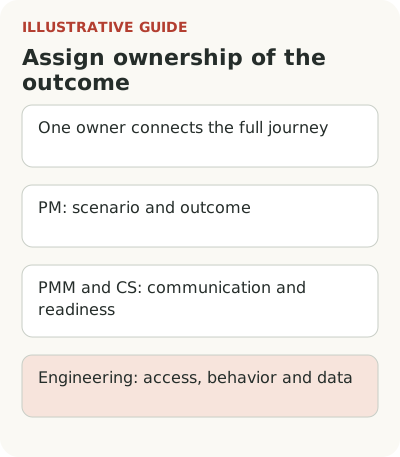
PM describes the task and work outcome, sets priority and constraints. PMM checks the value statement, audience, and launch materials. CS brings actual customer conditions, prepares support, and reports where instructions don't match reality. Engineering provides permissions, states, operation reliability, and technical measurement checks.
An analyst, if available, helps build a usable comparison and check definitions. Support prepares for new questions and returns the causes of stoppages. Not everyone needs to participate in every edit. For a small change, one person can fill several roles, but the decisions still need to be made.
Handoffs matter: PMM doesn't just pass on copy but shows it in the real product state; engineering doesn't just report an event but confirms its meaning; CS doesn't just forward a complaint but describes the conditions under which the person failed to achieve the outcome. The next participant then has a basis for action.
For task assignment, use the new feature launch checklist.
Launch continues after the announcement
Set a review date and an owner for remaining issues in advance. The meeting should answer who gained access, who could work, and what stopped the others. For immature cohorts, note when the full observation window will be available. Announcement day doesn't have to be outcome-assessment day.
Hélène Vincent's experience at TeamSupport describes how she reconsidered the division of responsibility for customer relationships. That's one organizational choice, not a ready-made structure for every company. It's more useful to check losses at your own handoffs than copy another company's entire department structure.
Keep launch materials where their owners can update them. Tooltip, article, and support answer should describe the same conditions. When a permission or step changes, someone must check the whole set. Otherwise, a month later each team will honestly tell the customer its own version of the product.
Before release, assign responsibility for the launch package.
Check one handoff now
Take the next launch and write the shared outcome in one sentence. Then name who decides audience, access, explanation, support, data, and stopping the release. For each handoff, name the concrete item passed on: a verified scenario, finished material, confirmed event, or list of constraints.
If a handoff has no owner, close the gap before announcing. You don't need a large responsibility matrix when one clear decision is enough. But hoping someone will notice a customer's problem after release usually costs more than a short conversation beforehand.