
A user activation event is an observable action or combination of actions that confirms a first benefit in a chosen journey. Start with the customer's job: what can they check, decide, or pass on? Profile completion and tour completion describe preparation until their connection to a result has been established.
First compare several candidates within one working journey. Then define the event source, audience, and window. Check the association with repeat work, but remember that correlation alone doesn't mean requiring the event will improve retention.
Describe the benefit before choosing an analytics event
Suppose a product helps teams approve contracts. “Created a workspace” describes the product's structure. “Received a decision on the first contract” describes the customer's work. Between them lie setup, document upload, choosing an approver, and the approver's response. Each transition is useful to track, but not all of them should be called activation.
In the hypothetical contract approval service, the candidates look like this:
| Candidate | What it confirms | Why it may mislead | How to refine it |
|---|---|---|---|
| Workspace created | Access to the product shell | A workspace can be created without a contract or task | Keep it as a preparation step |
| Contract uploaded | A source document exists | An empty template can also upload successfully | Separate real documents from practice documents |
| Contract sent to an approver | Work has been handed off | The recipient may not sign in or have authority | Check the recipient's access and the context delivered |
| Substantive response received | Another participant joined the decision | A practice response doesn't confirm a real review | Exclude tests and retain the link to the contract and account |
| Approval completed | The chosen working cycle is complete | A long external approval makes this a late signal | Count the early response and full cycle separately |
For a first launch, you might choose a received response as a hypothesis for early value if it actually resolves a customer's uncertainty. That decision needs observation. For a product where only a legally completed cycle matters, the same candidate would be too weak.
Ask customers what must happen for an evaluation of the product to be worthwhile. For a lawyer, it might be an approved document with a clear history of comments. For an operations manager, it might be the ability to see who is holding up the process. The system is the same, but the signs of first value differ.
Choose the main journey and define observable confirmation of the result. Don't try to fit the product's entire value into one condition. In PostHog's activation guide, a criterion can include one event, a number of events, or a combination of actions. The definition should follow the job, not the convenience of a report.
Compare an early signal with a completed working cycle
First value and sustained use don't have to arrive at the same time. Someone may immediately see where a contract is stuck but only run several approvals through the system over a month. If you require a monthly cycle to assess the first visit, the team will notice a startup problem too late.
The place of activation among other measures is covered in onboarding metrics. For event selection, define two levels of meaning. An early signal shows that someone could test the product's promise. Later confirmation shows that the way of working has taken hold. Each needs its own conditions and window. Don't call viewing a demonstration document a successful real approval.
The April issue of Growth Gems discussing a conversation with Daphne Tideman describes a distinction between first and core value. This is an opinion and working framework from a discussion focused mainly on subscription apps. For a B2B journey, connect it to the frequency of your own customers' work rather than transferring the timeframes given there.
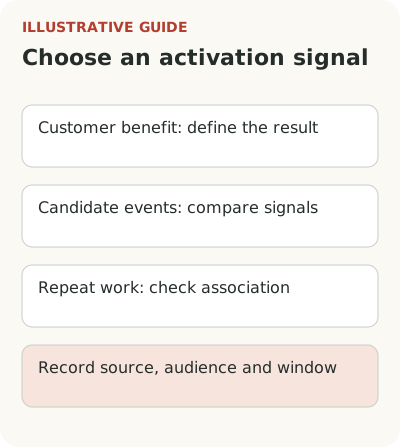
Check candidates within comparable groups
Collect several candidates: created a contract, sent it for approval, received a comment, completed approval. Then examine which actions are associated with repeating the target task in the next working period. Choose that period based on the actual frequency of contracts, not a habit of counting day seven.
Comparing “did something” with “did nothing” is too weak. People with a ready contract and an urgent task may already be more motivated. If they return more often, that doesn't prove a particular button caused their return. Compare available options among people who actually began work.
Check roles, acquisition channels, and access conditions. A customer who had a personal demo differs from someone who found instructions through search. A large company with an approver team ready differs from a person exploring alone. Look for associations within comparable groups first, then check whether they hold in others. A universal criterion can be a convenient but mistaken shortcut.
Exclude events that can be completed as a formality
Suppose analytics show a strong association between sending an invitation and returning. Making an invitation mandatory may be tempting. But someone can send one to themselves, to a nonexistent address, or to a colleague without a contract. The event occurs, but collaboration doesn't begin.
Refine the condition around its meaning: the recipient accepted the invitation and performed the required action on the document. If measuring an account, combine participants' events within one workspace. If measuring a lawyer's individual start, don't attribute the entire company's result to that person. Keep the unit of analysis consistent throughout.
Check the event source. A successful system response is more reliable than a button click when the operation can fail. Exclude practice data and employee actions where they distort the conclusion. Write these rules beside the metric name: without them, different analysts will soon build different versions of the same “activation.”
Record the definition and when to revisit it
Make a short agreement within the team: who enters the calculation, what action counts as the result, how much time is allowed, and which exclusions apply. For example, new working accounts with access to approval must complete their first real cycle within a chosen number of working days. Set the actual deadline from your observations and trial promise.
After changing onboarding, monitor whether people meet that condition and continue working. Treat closing a tour, reading instructions, and completing a checklist as supporting events. They help explain the mechanism but don't replace the result. If the main measure hasn't changed, you can't declare success just because more people open a tooltip. The substitution of training completion for a result is discussed in evaluating a product tour.
When data is scarce, start with an explicit hypothesis and an explanation of the mechanism. For example, a received comment shows that a second participant saw the document and joined the work. Then observe whether it helps the work continue. Don't call a hypothesis a discovered law just because you don't yet have a more convenient candidate. Save alternative definitions and the reason for your choice so the team can refine the criterion once enough real cycles have accumulated.
A separate analysis of the relationship between activation and retention needs mature cohorts and checks for other explanations. Even while choosing an event, look at reverse cases. Find accounts that completed the candidate event but didn't return, and those that continued working without it. The first group may have a formal practice result; the second may follow a different working path. This review doesn't replace analysis, but it shows what the criterion hides. If the alternative path is complete and occurs regularly, add it as a meaningful condition rather than forcing successful customers to take an extra step for a single chart.
Revisit the definition when the job, audience, or product changes. Keep versions of the metric so a new criterion doesn't look like a sudden increase in the old one. If the chosen event doesn't occur, investigate the reason people stop after signup. Start by listing three candidates and explaining the benefit each confirms. The one whose explanation amounts to “it's easy to count” should be the first to reconsider.