
You can model onboarding ROI by separating the project's cost from incremental profit and savings over the same period. Until you measure the incremental effect, the calculation shows a break-even threshold and the sensitivity of your assumptions, not a proven return.
Suppose a logistics service requires every new dispatcher to work out the route-upload rules by hand. Support answers similar questions, implementation delays launch, and a product manager proposes contextual guidance. A manager can reasonably ask why the team should spend time on this now. Start with the work you can verify, not someone else's growth percentage.
Before calculating, check whether the intervention itself fits: onboarding, a product fix, or a new feature. A budget for explanations won't fix a broken import.
A hypothetical ROI and model sensitivity
Compare incremental benefits with the full cost over one period: ROI = (incremental gross profit + confirmed savings − project cost) / project cost × 100%. The benefits must result from the change; don't count savings again in profit. A negative value means the project doesn't break even under those assumptions.
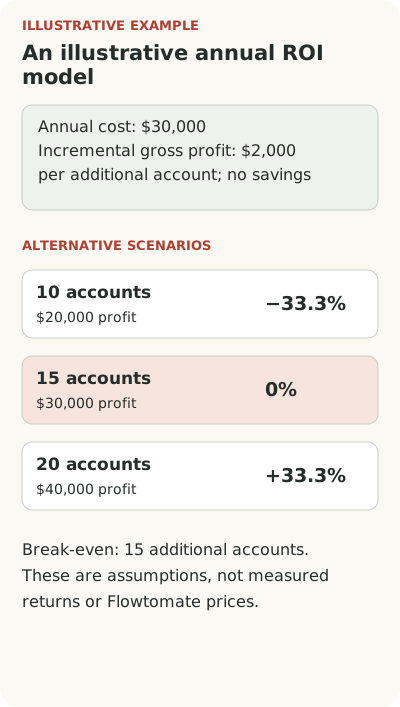
Consider a hypothetical annual calculation: the project costs $30,000, and the annual incremental gross profit from one genuinely additional paying account is $2,000. Assume no other savings. These are hypothetical planning assumptions, not a currency conversion or Flowtomate prices.
| Additional accounts per year | Incremental profit | ROI |
|---|---|---|
| 10 | $20,000 | ($20,000 − $30,000) / $30,000 = −33.3% |
| 15 | $30,000 | 0% |
| 20 | $40,000 | +33.3% |
These are scenarios, not company results or forecasts. Under these assumptions, the threshold is 15 additional accounts, not 15 accounts that paid after onboarding. Without a reliable estimate of the incremental effect, you don't know which scenario will occur. Separate revenue from gross profit, include implementation and maintenance costs for the same year, and don't credit onboarding for sales that would have happened anyway.
Gather evidence you can check
Choose one scenario and an observation period. Count eligible new accounts, stops at the relevant step, requests with the same cause, and staff time spent resolving them. Separate learning issues from failures and individual configuration. Each group calls for a different fix and offers different potential savings.
If support doesn't track time by topic, don't substitute a confident average from memory. Take a short sample and explain how you collected it. Twenty minutes recorded in a workflow log carries more weight than an assured “it usually takes an hour.” Show the variation: one difficult file can take half a week.
Base the monetary estimate on costs you actually know. An agreed hourly labor cost can help estimate team capacity used. But freed hours don't automatically reduce expenses: salaries don't disappear when staff answer fewer questions. Show what other work they could do and who will confirm that plan.
For help choosing an outcome, revisit onboarding metrics.
Separate facts, assumptions, and unknowns
Fact: a particular topic regularly prompts support requests. Assumption: an explanation next to the form will help some customers solve it themselves. Unknown: how many companies will change their behavior and whether that will affect payment. This structure makes the request honest and lets you discuss risk without false precision.
In Francesca Smedberg's interview about Rillion, onboarding appears in the context of a complex ERP product and work across several teams. Her experience is a useful reminder that some implementation work needs people and domain knowledge. It doesn't prove that a tooltip will remove all new-customer work in another service.
In the logistics example, the boundary might lie between the file format and agreeing on transportation rules. The format can often be explained on screen. The customer's rules still need a conversation with a person. Combine the two and the budget model promises to remove costs the tool doesn't touch.
Estimate the full cost of a small solution
Include more than the subscription or writing the copy. Account for preparing the scenario, setting up access, connecting data, checking events, testing, and maintenance after product changes. If guidance depends on a role, someone must ensure that role is correct. If you need to measure an outcome, the relevant event must exist and be verified.
An in-house solution requires engineering time and ongoing maintenance. A purchased tool still needs implementation, content, checks, and a vendor dependency. Compare the options over the same period and for the same scope. Otherwise, the external subscription sits next to only the cost of the first version of internal code—a convenient calculation, but a poor decision.
Don't demand an exact figure when the data doesn't exist. Give a range for unknown work and say what would narrow it: a technical check, a pilot scenario, or an access-requirements review. State the maximum first-stage spend separately. A bounded question is easier to fund than an endless “experience improvement.”
Include the cost of building in-house or buying a service.
Propose a stage with a clear decision
The first request can fund a test of one reason users stop. The team selects route uploads, describes an observable outcome, collects baseline values, and releases guidance to the appropriate group. The result should be more than a tooltip: decide whether to expand, change approach, or stop.
Agree on the criteria in advance. If people don't understand the guidance, revisit its wording and placement. If they understand it but the operation still fails, fix the import. If they upload successfully without a manager, you can assess the team's workload. With little traffic, the outcome may remain qualitative: the cause was addressed in observed tasks, while the size of any broader effect remains unknown.
Don't make revenue the primary metric for a short stage when the path to payment takes months and depends on sales. Choose the nearest verifiable outcome and keep the later connection under observation. This lets you avoid promising what you can't establish in that period.
For a monetary scenario, calculate the break-even threshold and keep it hypothetical. For example, how much additional paid work would cover the costs under your model? That is a question for a future test, not a growth forecast. State the assumptions linking activation to payment, what you know about margin, and which costs won't disappear. If you lack data for the model, base the budget on the verified problem and the cost of testing it. A blank is better than revenue calculated by multiplying an arbitrary percentage by the entire customer base.
Support requests need a separate review of recurring questions.
What to bring to a budget discussion
A short document is enough: the problem, eligible audience, verified cost of current work, solution options, and the first-stage limit. Show what the team won't do in order to take this work on. A budget uses more than money: the chosen task occupies people who could fix the product or meet another commitment.
Add conditions for revisiting the decision. If damaged files turn out to be the main cause, guidance should give way to data validation. If too few new dispatchers arrive to measure a monetary effect, don't expand the promise after the fact. Keep the scope small and rely on the cause addressed and actual costs.
Start with the last ten eligible cases and check how much work involved explanations. Then estimate the smallest way to help at that step. In Flowtomate, you can consider tours, checklists, and contextual tooltips for this task; your team still needs to prepare the budget and verify the outcome.