
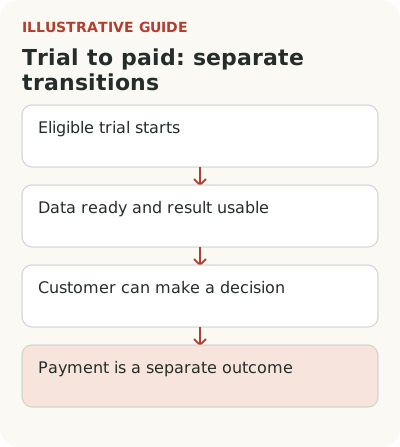
Trial-to-paid conversion may be low because a customer didn't have time to evaluate the product, or because they evaluated it and declined. Separate those outcomes before changing onboarding. Within the trial, trace data readiness, the first usable result, and the ability to make a decision; count payment as a separate event over a complete window.
If the trial ended during source connection, an email asking the customer to buy won't explain the value. But extending every trial won't fix an import error or a missing task either. First find the specific evaluation that remains unfinished.
Define a usable result for the payment decision
Suppose a service helps reconcile advertising spend with revenue. A customer wants to know whether they can trust the report and use it in a team meeting. Opening a sample dashboard isn't enough. They need real sources, a reconciled period, and a review of discrepancies. Moving the entire multiyear history may still be unnecessary for the first decision.
Describe the minimum usable trial result: a report for an agreed period with clear mapping rules and known limitations. Then establish who evaluates it and by what criteria. A product manager may consider the result ready when a chart appears; a finance employee may require checked amounts. Until those criteria align, time discussions are blind.
If first value is unclear, start with reasons for missing activation. Separate the first technical result from verified use. For some products they are close; financial analysis needs a check between them. Don't automatically call registration the start of a complete evaluation. But don't hide the commercial deadline either: people should know in advance when the clock started and what happens at the end.
Build a funnel from trial to purchase
Map the sequence: registration, sources ready, successful upload, first report, review, decision discussion. Mark where the user acted, waited for a colleague, or corrected a product error. A hypothetical two-week trial can contain very little evaluation time if access approval took almost the whole period.
This hypothetical funnel for one mature cohort shows where to investigate. The numbers illustrate the calculation; they are neither a standard nor a Flowtomate result.
| Confirmed stage | Accounts from the original 100 | Question to investigate |
|---|---|---|
| Eligible trial started | 100 | Are duration, offer, and inclusion criteria consistent? |
| Data and permissions ready | 65 | Why didn't the others prepare their sources? |
| Usable report received | 40 | Where did the drop occur between readiness and result? |
| Result checked and decision recorded | 30 | Was there enough time and were the right participants available? |
| Confirmed payment received | 18 | What prevented purchase after a complete evaluation? |
Payment conversion here is 18 / 100 × 100% = 18%, not 18 / 30. The latter describes a separate transition among those who completed evaluation. Before analysis, define the payment event, treatment of refunds, and window: for example, the full trial plus an agreed decision period. Show recent signups whose windows are incomplete separately. For extensions, retain the original cohort and distinguish a policy effect from selection of better-prepared customers.
Measure time from signup and separately from readiness of the inputs. The first describes the whole experience; the second shows the quality of work in the product itself. Start and end rules are covered in time to value. Alongside time, show the share of accounts reaching the result within the window. Speed among successful accounts alone says nothing about those whose trial ended during connection.
In the Participation Studio case study, users evaluated a product through a specific work task while onboarding asked them to set up a workspace. This published project shows a possible mismatch between the subject of evaluation and the start sequence. It doesn't establish the right trial length for other services. Choose that from your own work cycle.
Remove preparation that evaluation doesn't need
To shorten setup, list dependencies. For the hypothetical reconciliation, start with a limited period if it contains enough data for review. The full archive, report branding, and setup of every participant can wait. But don't remove currency mapping or source checks if the conclusion loses meaning without them. A shorter path must remain usable.
Show required materials and access before complex setup starts. If an advertising-account administrator is needed, the customer can involve them in time. Explain the boundaries honestly: which sources are available, what an example can demonstrate, and what will remain unverified without real data. A demo shouldn't present itself as a completed evaluation.
If an error causes the delay, fixing it matters more than another trial-ending email. If confusion is the obstacle, move help to the relevant action. If an external decision is required, provide a clear way to return to saved setup. These causes need different work even though all can appear in a report as “didn't pay after trial.”
Define the reason and goal for an extension
An extension makes sense when an unfinished evaluation is known, the next step is clear, and the customer is willing to take it. For example, access has been approved, the source is connected, and the remaining task is to reconcile the result with an internal report. The extra time has a purpose. “Try a little longer” without a task merely postpones the conversation.
Define the rules in advance: who can receive an extension, what is retained, which features remain available, and when to discuss the result again. Don't hide these conditions in individual agreements that product and support later understand differently. If an extension is manual, record its reason so the team can see recurring barriers.
Don't estimate its effect by comparing extended and non-extended accounts without qualification. Extensions usually go to people with particular readiness, a task, or contact with the team. They already differ from the rest. More purchases after extension don't prove that extra time itself caused them. For the decision, it is more useful to know which evaluation the extra time allowed them to finish.
Check payment separately from first value
Before the final day, explain what happens to access, created work, and the ability to continue. Payment and retention terms must match actual product rules. Don't promise data retention or no charge without checking. Users shouldn't discover the consequences of expiry from a suddenly closed report page.
Evaluate changes through several transitions: first usable result, independent repeat work, decision made, and purchase among eligible accounts. Keep the windows and account unit explicit. PostHog's funnel documentation highlights conversion windows and incomplete periods; recent cohorts also need time to finish their evaluation.
A refusal after complete evaluation can be useful: the customer understood a limitation they didn't see in the demo. A refusal before evaluation says something else. Separate these causes or the team will treat a mismatch between product and job with time and reminders. In a post-trial conversation, ask what decision the person could make and what evidence they lacked.
If the task occurs rarely, discuss its calendar before the evaluation starts. Starting immediately after a monthly close may be inconvenient regardless of interface quality. This is a question of preparing the trial with the customer.
Take the most recently completed trials and reconstruct the time from data readiness to a checked result. If almost none remained, find the owner of the delay and remove one cause. Change the deadline where time itself prevents completion of a clear evaluation, not where the team merely wants a more pleasant overall conversion rate.